Attention Deficit Hyperactivity Disorder
 Under IDEA (Individuals with Disabilities Education Act) children with ADHD may qualify for special education services in the category of Other Health Impairment (OHI).
This category is defined by the law as:
Other health impairment means having limited strength, vitality, or alertness, including a heightened alertness to environmental stimuli, that results in limited alertness with respect to the educational environment, that--
(i) Is due to chronic or acute health problems such as asthma, attention deficit disorder or attention deficit hyperactivity disorder, diabetes, epilepsy, a heart condition, hemophilia, lead poisoning, leukemia, nephritis, rheumatic fever, sickle cell anemia, and Tourette syndrome; and
(ii) Adversely affects a child's educational performance.
In Ohio, schools also use the definitions of disability categories as defined by the Ohio Department of Education (ODE) .
In Ohio, Other Health Impairment is defined as:
Other health impairment means having limited strength, vitality, or alertness, including a heightened alertness to environmental stimuli, that results in limited alertness with respect to the educational environment, that—
Is due to chronic or acute health problems such as asthma, attention deficit disorder or attention deficit hyperactivity disorder, diabetes, epilepsy, a heart condition, hemophilia, lead poisoning, leukemia, nephritis, rheumatic fever, sickle cell anemia, and Tourette syndrome; and Adversely affects a child’s educational performance. [§300.8(c)(9)]
It is critical to remember when considering ADHD as a learning disability, that it must adversely affect a child's educational performance. The level of support a student with ADHD varies child to child; some students with ADHD may be able to thrive independently in the classroom, some may need additional supports or modifications and some may need much more intensive help to be successful.
Who:
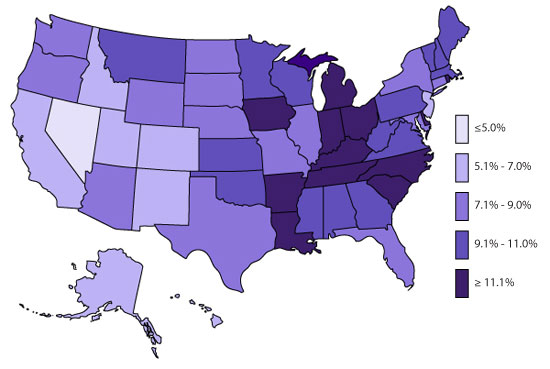 |
State-based Prevalence Data of ADHD Diagnosis (2011-2012): Children currently diagnosed with ADHD |
- Approximately 11% of children 4-17 years of age (6.4 million) have been diagnosed with ADHD as of 2011.
- The percentage of children with an ADHD diagnosis continues to increase, from 7.8% in 2003 to 9.5% in 2007 and to 11.0% in 2011.
- Rates of ADHD diagnosis increased an average of 3% per year from 1997 to 2006 [Read article] and an average of approximately 5% per year from 2003 to 2011.
- Boys (13.2%) were more likely than girls (5.6%) to have ever been diagnosed with ADHD.
- The average age of ADHD diagnosis was 7 years of age, but children reported by their parents as having more severe ADHD were diagnosed earlier.
- Prevalence of ADHD diagnosis varied substantially by state, from a low of 5.6% in Nevada to a high of 18.7% in Kentucky.
All information found on the CDC website

In the Classroom:
What does ADHD typically look like?
What are some strategies I can use to help a student with ADHD be more successful?
- provide clear, well defined classroom rules and frequently reinforce the rules
- put visual reminders of rules around classroom
- review rules before times they are likely to be broken (transitions, after long breaks from school)
- keep assignments brief, break longer assignments into smaller chunks that can be completed in smaller amounts of time
- provide direct instruction when possible
- teach note-taking strategies
- use partners or small groups
- keep presentation of materials/lessons in mind- novel, interesting and highly motivating material can help improve attention
- provide structure to lessons- can use graphic organizers or provide an outline of days agenda or notes
- incorporate auditory cues that signal different things throughout day
- provide productive physical breaks throughout day (walking something to the office, a classroom job etc.)
LD online provides more detailed information and additional classroom suggestions for students with ADHD

No comments:
Post a Comment